ಕೃDr. Krishna KolharKulkarniಡಾ. ಕೃಷ್ಣ ಕೊಲ್ಹಾರಕುಲಕರ್ಣಿ

Biography

Dr. Krishna KolharKulkarni

ಡಾ. ಕೃಷ್ಣ ಕೊಲ್ಹಾರಕುಲಕರ್ಣಿ

Historian of the Adil Shahis, Dasa Sahitya researcher, translator and author of eighty-four books

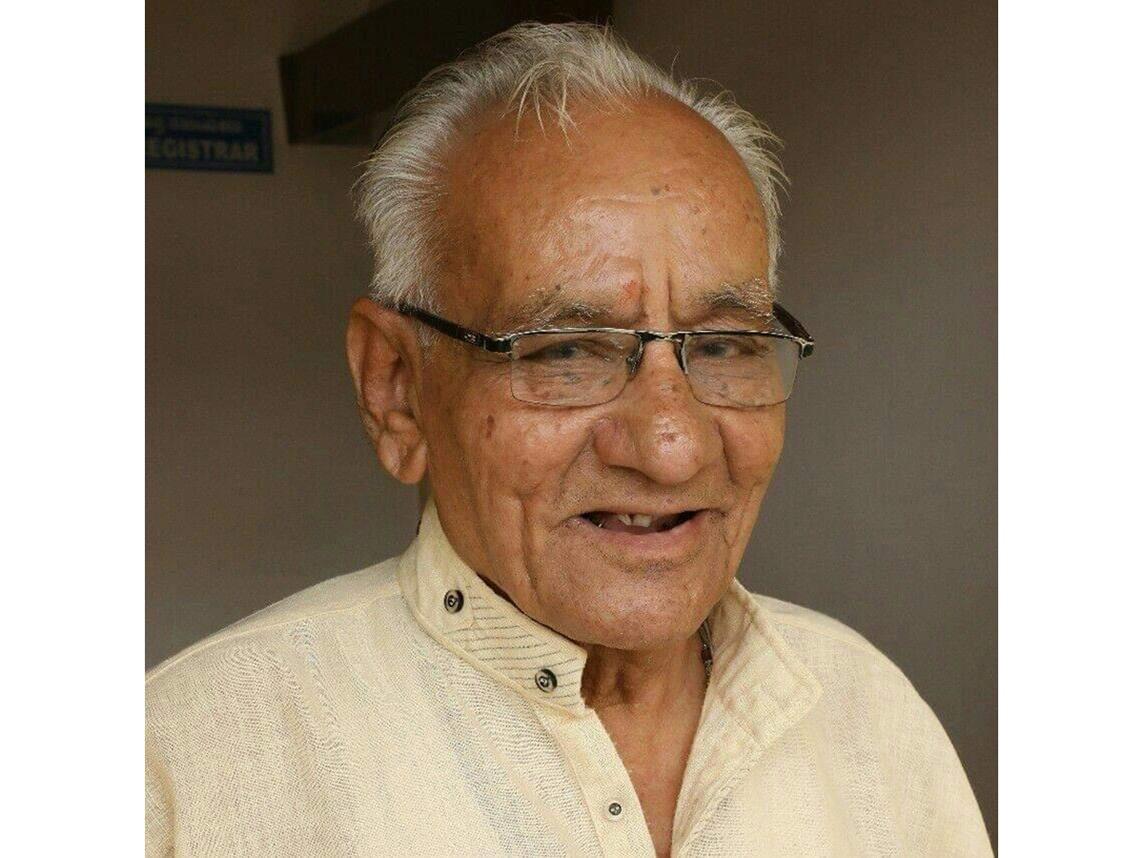
Portrait of Dr. Krishna KolharKulkarni
Full name
Dr. Krishna Hanumant Kulkarni
Known as
Krishna KolharKulkarni
Born
16 October 1940 — Kolhar, Vijayapura (Bijapur) district, Karnataka
Education
M.A., Mysore University (1985) · Ph.D., Gulbarga University (1989)
Languages
Kannada, Marathi, Hindi, Dakhani, Sanskrit, English
Based in
Keerti Nagar, Vijayapura 586101, Karnataka

A life in the record

Born in 1940 at Kolhar, Vijayapura district, Karnataka, Dr. KolharKulkarni took his M.A. and his Ph.D. while serving out a thirty-two-year career in the Department of Telecommunications — and spent those same decades on the literary and historical record of the Deccan.

Eighty-four books have followed, published by the Kendra Sahitya Akademi, the state academy, the universities of Hampi, Dharwad and Gulbarga, Bharatiya Vidya Bhavan and the Department of Kannada and Culture, with some translated into Marathi, English and Urdu. Several of his essays are set texts in Karnataka and Maharashtra schools.

  • Adil Shahi studies

    Directed the project that brought twenty-one Persian, Arabic and Dakhani manuscripts of the Bijapur Sultanate into Kannada in nineteen volumes — five of them his own translations. No Indian dynasty, the Mughals included, has been given comparable treatment.

  • Dasa Sahitya

    His doctoral thesis closed the supposed dark age of seventeenth-century Kannada literature, and he went on to edit four volumes of two thousand keertanas and serve on the editorial board of the state's fifty-volume Samagra Dasa Sahitya project.

  • Gamaka

    State president of the Gamaka Parishat from 2006 to 2009, and one of the form's leading vyakhyanakaras — the interpreters who gloss Kannada epic verse as it is sung.

  • Water in the Krishna basin

    When a Maharashtra dam left the Karnataka stretch of the Bheema dry and both governments were deadlocked, he took the case to the Supreme Court and won the release of water — then a tribunal allocation for river flow that is now the national model.

Dr. Krishna Hanumant Kulkarni — who writes and is known in Kannada as Krishna KolharKulkarni — is a social worker, scholar, researcher, historian and creative writer. Born on 16 October 1940 at Kolhar in the Vijayapura district of Karnataka, he took his M.A. from Mysore University in 1985 and his Ph.D. from Gulbarga University in 1989. He is the author of eighty-four books, published among others by the Kendra Sahitya Akademi, the Karnataka Sahitya Akademi, the universities of Hampi, Dharwad and Gulbarga, Bharatiya Vidya Bhavan Bengaluru, the Department of Kannada and Culture, and the Kannada Sahitya Parishattu. Several have been translated into Marathi, English and Urdu, and some of his essays are set texts in Karnataka and Maharashtra schools.

The work, strand by strand

Literature and history first, then the public work that grew out of them — heritage, water, gamaka and the press — and the departmental career that ran alongside all of it.

Kannada literature

A doctorate in Kannada literature, and six decades tracing the language and its writing from the ancient record to the present day.

  • His doctoral thesis (1987) overturned the received view that the seventeenth century was a dark age in Kannada literature, establishing for the first time that no such gap exists.
  • Explored and edited four volumes gathering two thousand keertanas — the devotional compositions of that period.
  • Editorial member of the Government of Karnataka's Samagra Dasa Sahitya Prakatana project (1995–2003), published in fifty volumes.
  • Edited Na. Shri. Rajpurohitar Samshodhana Lekhanagalu and the Na. Shri. Rajpurohit books, 1910–1953, for the Department of Kannada and Culture (2008).
  • Edited the works of Ra. Ha. Deshpande (1860–1930) in two volumes for the same department (2016).

History of the Deccan

Regarded as an authority on the medieval history of India, and on the Adil Shahis of Bijapur in particular.

  • Argued and demonstrated that the medieval history of India — of Karnataka above all — is incomplete without a detailed study of the Adil Shahis, who ruled this part of the country for close to two hundred years.
  • The Adil Shahi court drew poets and historians from across the medieval world, writing in Persian, Arabic and Dakhani. Those manuscripts lay scattered across India and abroad; under his directorship twenty-one of them were brought into Kannada in nineteen volumes, five of which he translated himself. No Indian dynasty, the Mughals included, has been given comparable treatment.
  • Principal titles: Kitab-e-Nauras (1996), Bijapur the Wonder Land (1998), Adilshahi Asthana Sahitya (1998), Busatine Salatin (1999), Bijapur Adilshahi (2002).
  • Organised international, national and state conferences on history and architecture — among them the international seminar on The Place of Indian Architecture in the World History of Architecture, with AICTE New Delhi (January 2004), and the national seminar on Bijapur Architecture (2006).
  • Advisory committee member for the Bijapur District Gazetteer (1997–2000) and, from 2017, the Bidar District Gazetteer.

Heritage & conservation

Convener of the INTACH Vijayapura chapter since 2000, and a member of the INTACH governing council in New Delhi from 2011 to 2015.

  • Sustained work on the conservation of monuments and the environment, and on public awareness of cultural heritage.
  • Published the HERITAGE calendar (2005–2010) to promote tourism, Parampareya Kaipidi — Hands on Heritage — for students (2009), and My Tale, a Heritage Building of Bijapur (2014).
  • Opened 120 heritage clubs in 120 schools across eight districts of Karnataka.
  • Ran training programmes for teachers and students on culture and heritage.

Translation & languages

A polyglot at home in Kannada, Marathi, Hindi, Dakhani, Sanskrit and English, who has translated from all of them.

  • Tukaram, for the Kendra Sahitya Akademi.
  • The Mahatma Gandhi volumes, for Bharatiya Vidya Bhavan, Bengaluru.
  • Busatine Salatin, for Kannada University, Hampi.
  • Member of the Urdu Academy (1998–2001).
  • Karnataka Anuvada Sahitya Academy award (2005) for lifetime achievement in translation.

Gamaka

Gamaka — the sung, interpretive recitation of Kannada epic poetry — is the one form through which those poems reach an ordinary listener's ear.

  • Widely regarded as one of the finest gamaka vyakhyanakaras, the interpreters who gloss each verse as it is sung.
  • State president of the Gamaka Parishat (2006–09), running programmes across Karnataka and in Delhi and convening two state-level conferences.
  • Arranged scores of gamaka performances and trained primary and secondary school teachers in the form.

Journalism

A prolific columnist whose essays have appeared in nearly every periodical in Karnataka, on subjects from politics to poverty, religion to roads.

  • Regular columnist for the Kannada dailies Samyukta Karnataka and Usha Kiran.
  • Closely researched articles in university journals across the state; several are set texts in Karnataka and Maharashtra school books.

Agriculture & irrigation

A long campaign on water in the Krishna basin that ended in the Supreme Court, and changed how river flows are allocated nationally.

  • A dam across the Bheema in Maharashtra had left the Karnataka stretch of the river completely dry, affecting more than a hundred villages on its banks along with their cattle, flora and fauna. With the state and central governments deadlocked over an inter-state dispute, he approached the Supreme Court and obtained an order directing the release of water from the Maharashtra dam.
  • He then won a separate allocation from the Krishna Water Tribunal to maintain the flow of rivers in the basin — a principle now applied to every river basin in the country.
  • Published Supreem Kortinalli Bhorgareyuva Bheema Neeru and Karnataka Neeru Neeravari, both acclaimed by state and national experts on the subject.
  • Studied the Upper Krishna Project in detail and wrote extensively on its construction and on rehabilitation and resettlement; member of the state committee on UKP rehabilitation and resettlement (2000–2004).
  • Founder president of Punarvasati Grama Vikas Sangha, Kolhar (1996), which resettled people displaced by submergence with the basic facilities for living.
  • Studied agricultural practice in the district and worked to develop horticulture around Vijayapura — onion and grapes in particular.

Folklore

A long-standing interest in folk literature, carried into performance and broadcast.

  • Conducted folklore programmes and recorded original folk literature on audio cassette.
  • Wrote programmes for All India Radio stations across Karnataka.

Organiser & cultural ambassador

Wherever a posting took him, he built a Kannada institution and left it standing.

  • Bombay, 1960–71: founded the Kannada Friends Circle, established a library, and ran literary and cultural programmes.
  • Belgaum, from 1971: promoted Kannada among ordinary people through cultural, religious and literary programmes.
  • Raichur, 1973–80: elected president of the Karnataka Sangha Raichur (1978–80), the second largest institution of its kind in the state.
  • President of the Karnataka Posts and Telegraph Writers and Artists Association (1982–92), organising state-level conferences and publishing the monthly magazine Pratibha.

Career

Thirty-two years in the Department of Telecommunications, and a second, academic life built alongside and after it.

  • Served in the Department of Telecommunications from 1960, taking voluntary retirement in 1992; trained as an officer in planning, management and administration.
  • Post-doctoral research on Hindu–Muslim relations during the Adil Shahi period, under an ICHR senior fellowship (1993–95).
  • Principal of VVS Degree College, Bijapur (1995–97).
  • Honorary director of the Institutions of Adil Shahi Studies, Bijapur (1997–2004).
  • Director of the Dr. P. G. Halakatti Research Centre, Vijayapura since 2007, having served on its board of studies; guide to Ph.D. students under Kannada University, Hampi.
  • Member of the Kannada Anushthana Samiti of Karnataka State Women's University, Vijayapura, since 2009.

Awards & recognition

Awards, citations and felicitations from the Government of Karnataka and from the state’s literary academies, maths and cultural institutions — most recent first.

  1. Aaroodha

    2026

    Lokashikshana Trust, Hubballi–Bengaluru

  2. Kanaka Purandara

    2026

    Hubballi

  3. Madhva Purandara

    2026

    Bengaluru

  4. Kannada Kayaka

    2024

    Kannada Sahitya Parishattu, Bengaluru

  5. Jayapramod Anugraha

    2022
  6. Yalaguresha Anugraha

    2022
  7. Karnataka Sahitya Academy Award

    2021

    Karnataka Sahitya Academy

  8. Karnataka Rajyotsava Prashasti

    2021

    ಕರ್ನಾಟಕ ರಾಜ್ಯೋತ್ಸವ ಪ್ರಶಸ್ತಿ

    Government of Karnataka

    The state's highest civilian honour, for lifetime contribution to literature and history.

  9. Shamba Prashasti

    2020

    Karnataka Sangha, Shimoga

  10. VC Sampada felicitation

    2017

    VC Sampada, Bengaluru

  11. Sunita Shetty Shreshtha Kannadiga Prashasti

    2016

    Mumbai Kannada Sangha

  12. Jagannatha Vitthala Prashasti

    2016

    Vishwa Madhva Parishattu, Kalburgi

  13. Bendre Prashasti

    2016

    Sindgi

  14. Madhyama Siri

    2015

    Bengaluru North Karnataka Balaga

  15. Prasanna Venkata Prashasti

    2015

    Haridasa Habba

  16. Kanaka Prashasti

    2015

    Shri Revanasiddheshwar Vidya Peetha, Dharwad

  17. Gamaka Mahipati

    2015

    Gamaka Parishat, Hosahalli

    For his work as a gamaka vyakhyanakara.

  18. Gaffaria Bhavaikya Prashasti

    2013

    Gaffaria Pratishthana

  19. Kanaka Shri

    2013

    Government of Karnataka

    For all-round achievement in research, history and translation, and in Dasa Sahitya above all. Carries ₹5 lakh and a citation.

  20. Galaganath–Rajpurohit Prashasti

    2007

    Galaganath–Rajpurohit Pratishthana, Dharwad

    Lifetime achievement in research in Kannada literature.

  21. Karnataka Anuvada Sahitya Academy Award

    2005

    Government of Karnataka

    Lifetime achievement in translation from several languages into Kannada.

  22. Haridas Sahitya Bhushana

    1990

    Shri Shripadraj Math, Mulbagilu

Written about

Nadoja Patil Puttappa wrote on him in Taranga weekly (9 August 1995), Dr. Ha. Ma. Nayak in Sudha weekly (30 November 2000), and Shri Chiranjeevi in Tushara monthly (July 1992); others have followed, in periodicals and in books.

Karnatak University Dharwad awarded a Ph.D. to Dr. Sumitra D. Savant in 2011 for her thesis on the life and literature of Dr. Krishna KolharKulkarni.

A man from a remote village in Bijapur, then among the most backward districts of Karnataka, who made his own opportunities: he took his M.A. and his Ph.D. while serving in a non-academic department, and rose academically, socially and culturally to become a model for others.

Eighty-four published titles

History, Dasa Sahitya research, translation from Persian, Urdu and Marathi, and Kannada linguistics — available as hard copies and e-books.

Explore the library